



This piece first appeared in our AI & The Workforce newsletter, which looks at how AI is changing how we work and lead at the largest companies and what it means for people leaders. In this edition, Valence Chief AI Scientist Jeff Dalton takes on a question every enterprise leader is now facing: when does work actually call for an AI agent, and how purpose-built does it need to be? Subscribe for each new edition.
Agents aren't new.
In 1972, researchers at SRI built Shakey, a robot that looked like a filing cabinet on wheels. Someone could tell it in plain English to push a block off a platform, and it would model the room, plan a route, act, bump into things, and adjust until it succeeded.
Shakey was one of the first true agents, at least by the research definition, which hasn't changed since he first bumped around the lab: an agent is a system that models its world, then plans, acts, observes what changes, and updates its model and behavior based on the outcome. An agentic system runs that loop continuously.
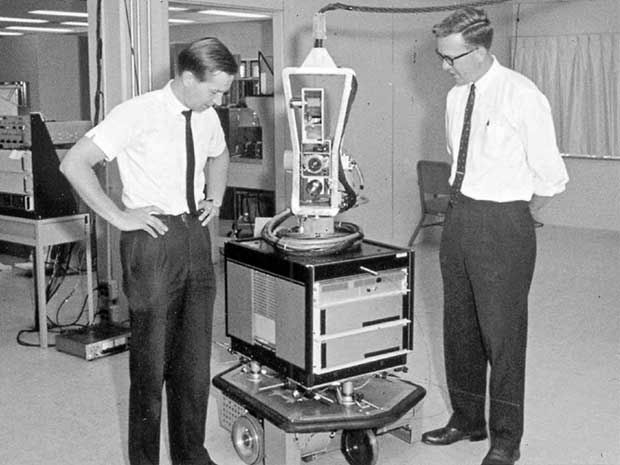
Today, a lot of what gets called an agent would not have looked very agentic to the people who built Shakey. These “agents” might answer, draft, summarize, or trigger a workflow, but they do not maintain much of a world model, adapt over time, or decide what to do next based on what changed. I wrote a recent blog, What Is an Agent, Actually?, on how to tell if something is an agent. But there's a related question even more relevant for enterprise leaders: does this work actually need an AI agent?
Gartner recently called out "agent washing," the rebranding of existing chatbots, assistants, and automation tools as agents without substantial agentic capabilities and put agents at the peak of inflated expectations in its 2026 AI hype cycle. Yet, in the lab, these systems are advancing at a rate that is easy to underestimate. The length of a task that a frontier system can complete on its own has doubled roughly every seven months for six years and technical workers now report getting about twice the value from AI-supported work than they did a year ago.
It’s important for business leaders to understand that frontier AI systems are no longer just LLMs. They are LLMs with an agentic harness, which is the software environment and the operating system that gives LLMs access to APIs, tools, and memory and often turns a model into an agent. Give the same model a better harness and it plans further ahead, recovers from its own mistakes, and finishes longer tasks.
However, faster, more capable models and agents do not mean everything will collapse into one general AI system that can do anything with the right harness. The more work depends on premium human expertise and specialized content (i.e., data), the more likely it will need a purpose-built agentic system with the right expertise, guardrails, and integrations.
I’m at Valence because I believe AI coaching is an example of work that requires a purpose-built system. With the right harness, someone could build an okay coach quickly on an LLM, but building an AI coach that can be trusted to coach a 50,000 person organization across a range of dynamic situations requires a highly specialized system with custom memory.
5 Questions to Ask about Agentic AI
So what work actually needs an agent, and how specialized does the agent need to be?
- Does the work have a long horizon? If it resolves in one sitting, a simpler tool will likely do; if it unfolds over time, you probably need an agentic system.
- Does the decisive context live inside your organization, and how specialized and sensitive is that context? If the usefulness of the AI depends on knowing your people, your frameworks, your history, you need a system capable of modeling that complexity and updating it as it evolves.
- Does it need to act, not just answer? Drafts, schedules, follow-ups, and updates require a system that can be trusted to know when and how to act.
- Does it need to remember, and how specialized is what it needs to know? Memory is one of the frontiers of AI research, but effective memory isn’t just what the system knows, it is how well the system applies the right information to a given task.
- Does the value compound if the system improves? A chatbot answers the same way in month six as in week one. For some tasks, doing something the same way every time is valuable.
As Nico Orie, VP of People and Culture at Coca-Cola Europacific Partners, recently posted AI agents may become some of our most expensive employees. Employees come with benefit costs; AI comes with token costs. While a chatbot carries a predictable subscription fee, an agentic system carries significant costs in compute, integration, and maintenance that pay off only when the value of that system compounds with use.
For enterprise AI, this means matching the AI to the work. Producing a document may not require a full multi-agent system, but helping a manager change how they run one-on-ones needs a system that understands how people work, decide, and change.
If the answers to the above questions are mostly no, then an LLM can likely handle it. If they are mostly yes, you are looking at the kind of workflow where the biggest workplace transformations are likely to happen in the next five years, and a purpose-built system is likely to deliver outsized value over time.
P.S. A few of my favorite readings, for anyone who wants more of a technical primer on agents.
- Russell & Norvig, "Artificial Intelligence: A Modern Approach." The 4th edition of the definitive AI textbook.
- Anthropic, "Building Effective Agents." A frontier lab's plain-language guide to agents versus workflows.
- Chip Huyen, "Agents." Adapted from the agents chapter of her book AI Engineering, a single practitioner's overview of how agents are actually built: tools, planning, memory, and the places they still fail.
More from Jeff on AI agents in the enterprise
→ Part 1: What is an Agent, Actually?
→ Part 2: A Multi-Agent System for Coaching
The Field Report
The latest conversations, questions, and reads on AI and the workforce, curated for people leaders.
1. 📊 Quantifying the gap between AI adoption and fluency
In the news: Around the same time 92% of CHROs told SHRM they expect AI woven deeper into their workforce, a Go1 survey of 2,000+ L&D leaders and workers found that 7 in 10 professionals now use AI weekly, yet only 14% would call themselves advanced users. Executive ambition and workforce capability are moving at visibly different speeds, and the distance between them is becoming the real constraint on every AI strategy.
Why it matters: "The biggest need for upskilling and reskilling in my lifetime, and perhaps ever," per Chris Eigeland, Go1's CEO.
The HR read: Closing the distance between 70% usage and 14% mastery is a talent and L&D mandate, and the leaders rewriting their roles around it may have one of the most consequential jobs in the building.
2. 📐 Rewriting the job of managers
In the news: AI is evolving the role of managers. A recent Korn Ferry survey found 41% of employees are in companies that are flatter than they were a year ago. Deloitte's 2026 Global Human Capital Trends survey of 9,000+ leaders found AI is increasingly augmenting decision-making and leadership. 60% of executives now regularly use AI to support their decisions, and Gartner projects half of business decisions will be AI-augmented or automated by 2027.
The big picture: Flatter organizations are just one of the ways AI is changing management.
- Collaboration becomes more important. With fewer layers, spans widen and escalation paths disappear, and work gets done through collaboration rather than hierarchy.
- Managers expectations drive AI adoption. A Checkr survey found managers increasingly treat AI use as an unspoken performance expectation.
- Managing the machines. As agents execute more work, everyone becomes a leader in the loop, delegating tasks by prompting AI, reviewing AI outputs, and exercising judgment through iterations. Cognizant's CEO calls the people doing this well "player-coaches": they execute with AI and they develop others.
The HR read: Talent leaders now have to develop a different kind of leader: one who can operate as a player-coach, collaborate across functions where hierarchy used to do the coordinating, and integrate AI into their teams and work.
3. 🧭 The Chief People Officer is now an AI leader
In the news: Prudential stood up a Center for AI in early 2026 to govern and scale AI across the company, and recently named its Chief People and Experience Officer, Vicki Walia, to co-lead it alongside Scott Case, head of Global Technology and Operations.
The big picture: Prudential shows how a major Fortune 500 company is putting strategic HR and IT leadership at the center of its AI investment. Its Chief People Officer co-owns the strategy because preparing people for a new way of working is one of Prudential's three AI pillars. The work is already underway: 260+ AI use cases in flight, including a global deployment of Valence's Nadia for leadership development and performance management, and a Tech-Ready Academy that builds genuine skills.
The HR read: Prudential is a preview of where the CPO role is going: HR helping to architect how an entire workforce learns to work in a new way, from the start.
4. 🏗️ OpenAI’s $4B bet that deployment is the hard part
In the news: In enterprise AI, deployment is often the hardest part, and OpenAI just put $4B behind a new Deployment Company that will embed forward-deployed engineers inside enterprises to redesign core workflows and operations.
Why it matters: While the technical architecture of agents belongs to IT, the organizational architecture (how human-and-agent teams are designed, what the work itself looks like) is a workforce-planning question that lives with HR. And so far, HR hasn't been part of the OpenAI initiative.
The HR read: Valence advisor and former IBM CHRO Diane Gherson started a LinkedIn thread worth reading on the initiative. In it, she cautions that forward-deployed engineers are "today's Taylorist industrial engineers" and urges a systematic approach to work redesign, one that protects the on-the-job experiences that build judgment and develop the people who'll understand the work as AI does more of it.
[[button-cta]]
Lorem ipsum dolor sit amet, consectetur adipiscing elit. Suspendisse varius enim in eros elementum tristique. Duis cursus, mi quis viverra ornare, eros dolor interdum nulla, ut commodo diam libero vitae erat. Aenean faucibus nibh et justo cursus id rutrum lorem imperdiet. Nunc ut sem vitae risus tristique posuere.
Lorem ipsum dolor sit amet, consectetur adipiscing elit. Suspendisse varius enim in eros elementum tristique. Duis cursus, mi quis viverra ornare, eros dolor interdum nulla, ut commodo diam libero vitae erat. Aenean faucibus nibh et justo cursus id rutrum lorem imperdiet. Nunc ut sem vitae risus tristique posuere.
Lorem ipsum dolor sit amet, consectetur adipiscing elit. Suspendisse 2 varius enim in eros elementum tristique. Duis cursus, mi quis viverra ornare, eros dolor interdum nulla, ut commodo diam libero vitae erat. Aenean faucibus nibh et justo cursus id rutrum lorem imperdiet. Nunc ut sem vitae risus tristique posuere.
Lorem ipsum dolor sit amet, consectetur adipiscing elit. Suspendisse 3 varius enim in eros elementum tristique. Duis cursus, mi quis viverra ornare, eros dolor interdum nulla, ut commodo diam libero vitae erat. Aenean faucibus nibh et justo cursus id rutrum lorem imperdiet. Nunc ut sem vitae risus tristique posuere.
.png)
