


Almost every enterprise software vendor is selling agents, but most of what is being sold is not actually an agent, and the gap between the marketing and the technology matters for an enterprise deciding where to invest.
The systems being called agents fall into two different categories. The first will answer a question well today and answer the same question, the same way, six months from now. The second is designed to learn from the work, build context across many conversations, and become meaningfully more useful over time.
Only the second of these systems is an agent, as an AI researcher would define it. The first is a tool claiming to be an agent; the second is a system that compounds value as it learns and improves.
In this post, the first in a two-part series on agentic AI, I’ll explain how to discern true multi-agent systems with multiple agents architected together from chatbots and single agents. Then, in a future post, I’ll walk through how we’ve architected Nadia to be a multi-agent system, since coaching depends on a working model of a person, their team, and their organization, and on that model becoming more accurate over time.
The definition of an agent hasn’t changed. The environment and action space have.
While agents are poorly defined by many enterprise vendors, the research definition has been consistent for almost 50 years. Agentic AI research and multi-agent systems trace back to the 1970s, and even before generative AI, many of us used agents, such as the Google Assistant or Siri, in everyday life.
An agent is a system that maintains a model of the world, formulates a plan, executes actions within that world, observes the resulting state changes, and updates its behavior based on outcomes.
If that definition feels abstract, here is a concrete example. In 1972, researchers at SRI International created Shakey, a robot that looked like a filing cabinet on wheels with a TV camera bolted to the top. Shakey could be given a goal in plain English, such as “push the block off the platform,” and Shakey would reason its way through it, by building a model of the room, planning a sequence of steps, navigating to the platform, and adjusting when something went wrong, until it succeeded. It was slow, and it bumped into things, but by the formal definition, Shakey was an agent.
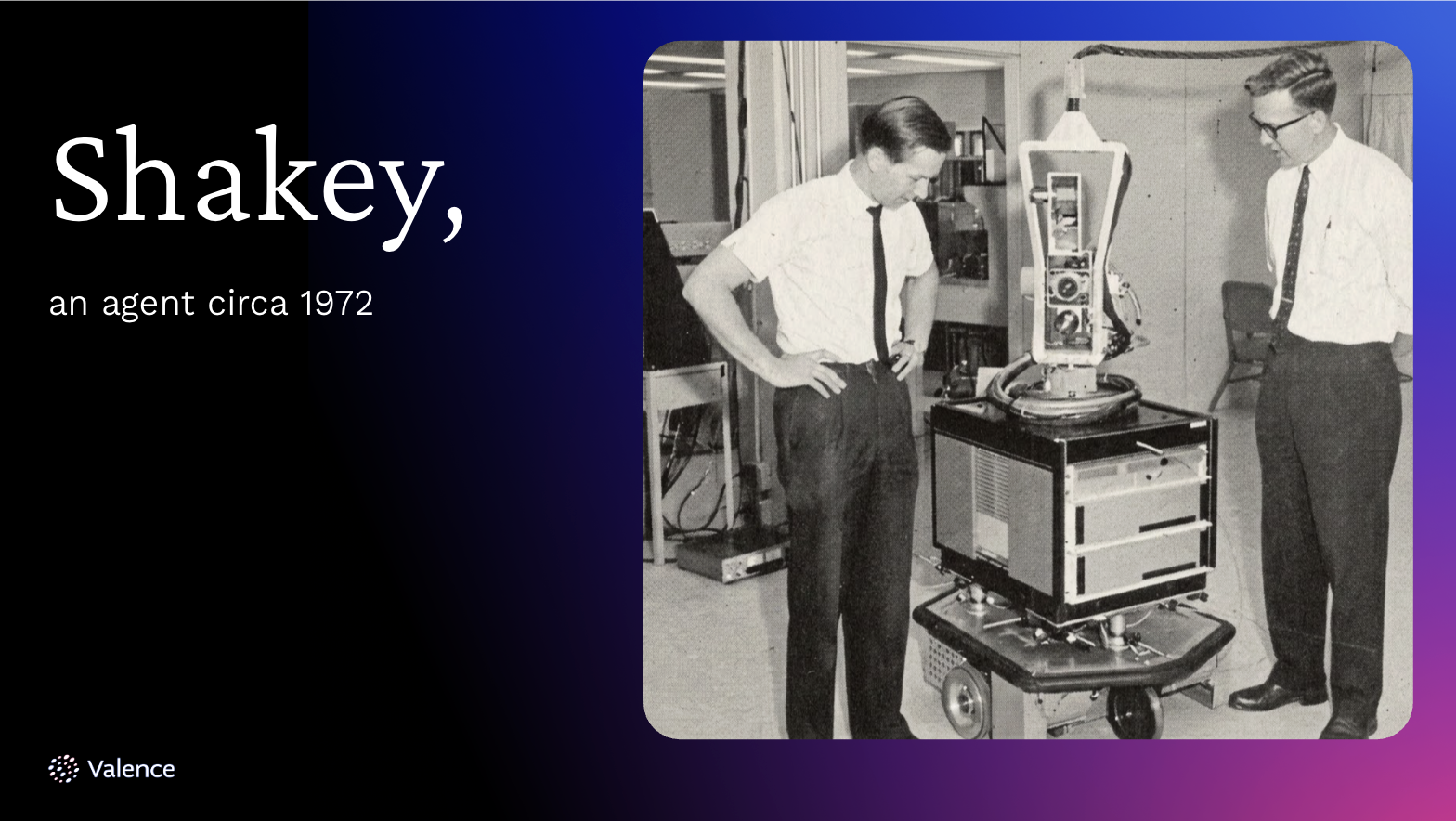
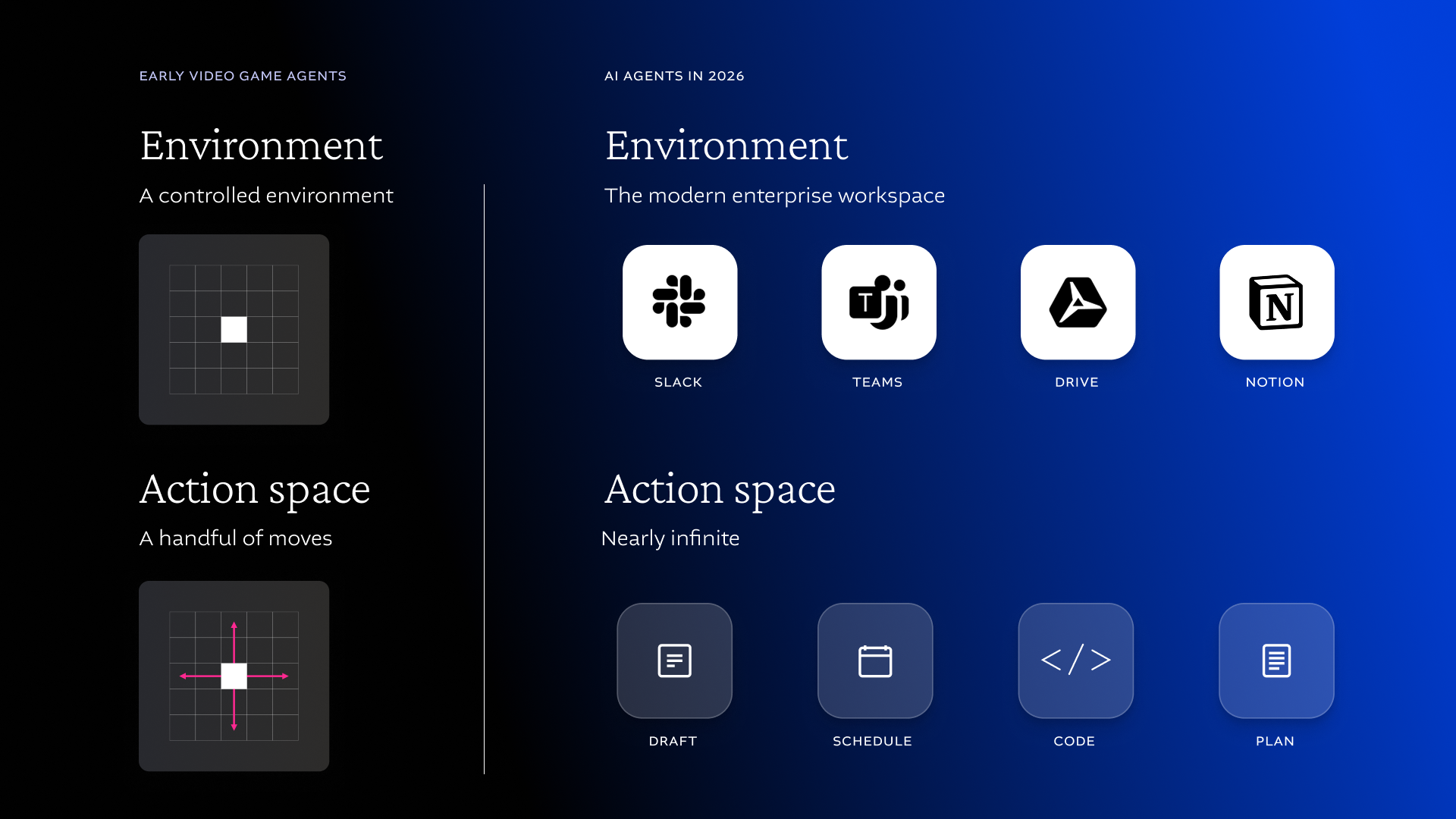
While the definition of agent has not changed since Shakey, the world an agent operates in has, both in terms of the environment agents operate in and the action space, or what you can do in that environment. Shakey navigated an environment and action space that were limited and deterministic. Similarly, early video games had simple agents, who navigated a virtual world through a handful of moves.
With large language models and generative AI, an agent's environment can now include the documents on your file system, the messages in your inbox, the code in your repository, or the meetings on your calendar. AI agents can draft and send messages, write code, schedule meetings, produce structured artifacts, and more. Even something as seemingly simple as drafting an email has an immense action space, since each new word is a choice and the action space is every word in the dictionary.
A model and chatbot are not the same as an agent.
Much of what is currently marketed as "AI agents" is in reality chatbots powered by a foundation model, such as GPT-5, Opus, or Gemini.
Over time, foundation models have adopted some capabilities similar to agents. Modern reasoning models, for example, run their own internal planning loops on every response, and models themselves are increasingly capable of using tools and planning across steps.
But even if a foundation model may reason impressively and act as a lightweight agent, models are also general-purpose by design. They remain static, with learning frozen after training, and can’t easily or automatically maintain consistent or deep knowledge of you or a particular situation. They have no environment beyond the text prompts and no persistent action space beyond generating text in response to a prompt. Anything more, such as the ability to read your files or schedule a meeting, has to be built around this.
In a fast, narrow exchange, such as drafting an email or summarizing meeting notes, chatbots can give you a good answer, but there is typically no persistent memory between sessions, no planning horizon, and minimal capacity for follow-through.
An agent is built for hard problems, with many steps, that unfold over hours, days, or weeks.
Unlike a chatbot, an agent plans, searches, calls tools, compares evidence, cites support, remembers prior context, and synthesizes answers across steps and sessions. It also decides when it has done enough and stops; knowing when to stop is a critical part of being an agent.
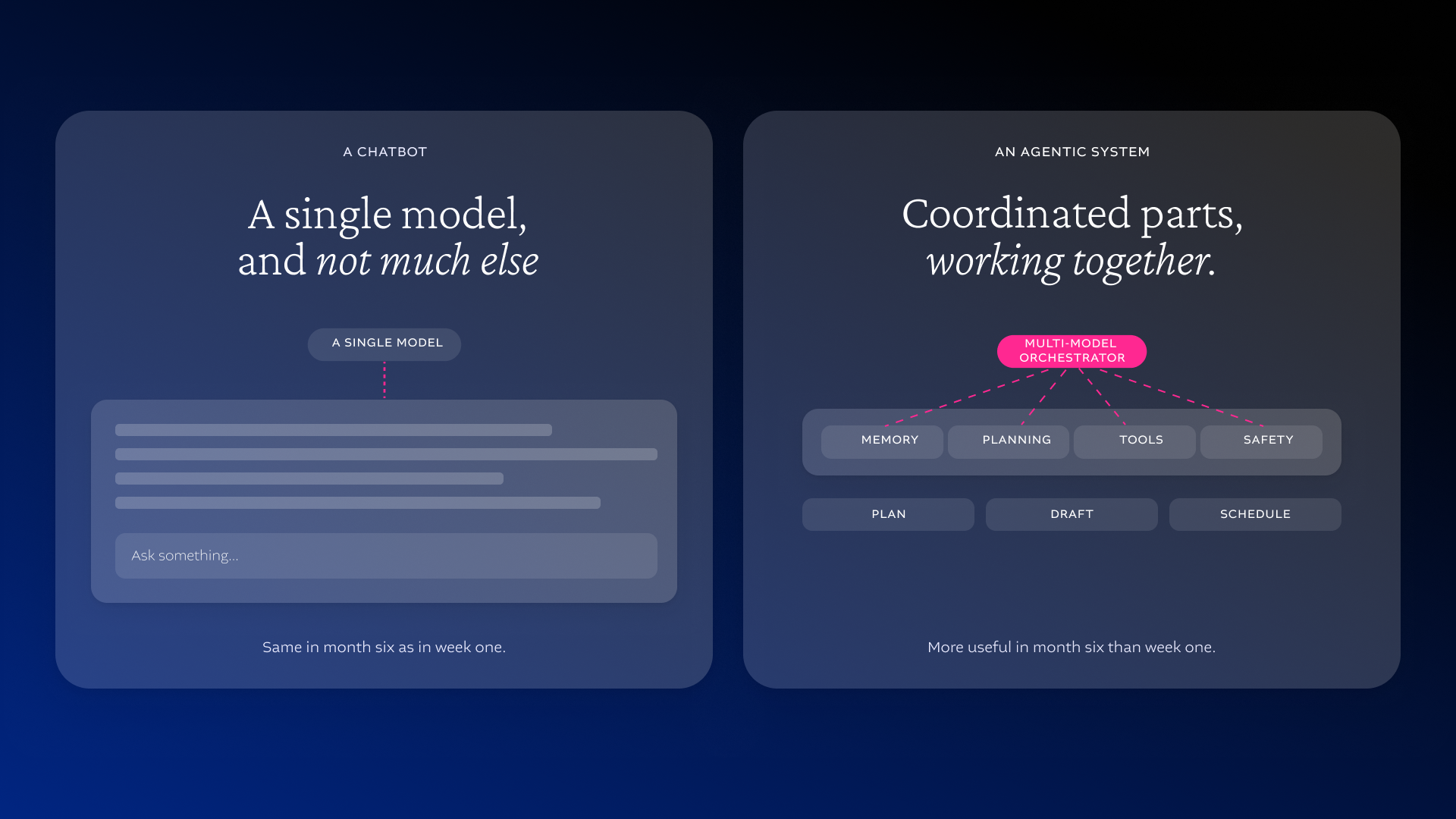
An agentic system goes a step further and coordinates multiple specialized components and agents through an orchestration layer. The orchestration layer provides the coordination mechanism to determine which sub-agent or component handles which part of a task, how information flows between them, and how outputs are assembled. Instead of one model doing everything, you have a team of specialized sub-agents working together under a coordinator, often utilizing multiple models.
In practice, this means that when a user prompts an agentic system, several agents work in concert: one synthesizing context from past interactions, another reasoning about what intervention or response is appropriate, another monitoring for safety, and so on. Each is purpose-built for its part of the job. The intelligence lives in the models, but the quality of the system comes from the orchestration and coordination across agents within a system that learns and improves over time.
If your agent can’t plan, act, observe, and learn, it is not an agent.
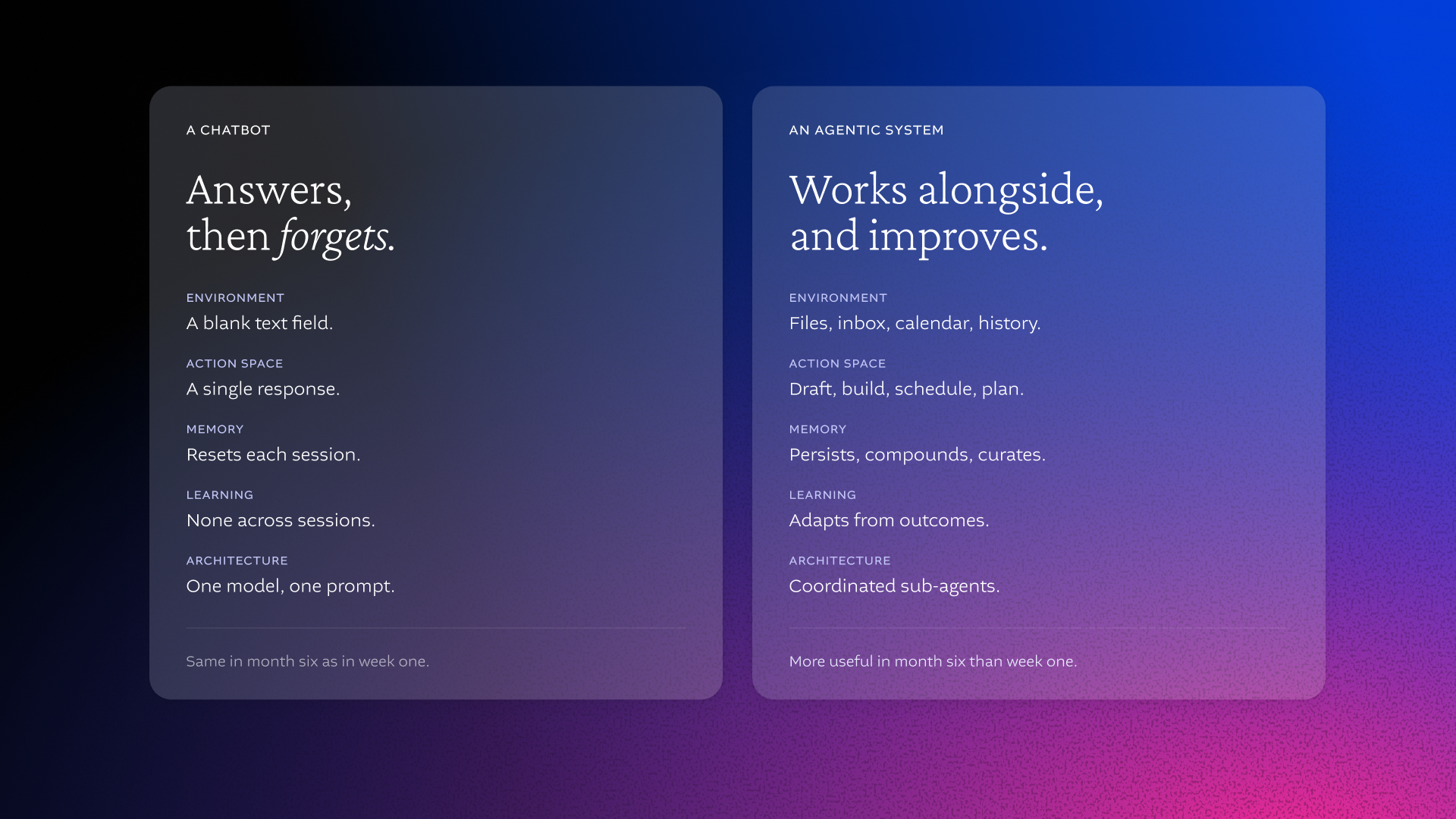
A chatbot and an agentic system may look the same on day one, but a chatbot answers the same way in month six as it did in week one. An agent, by design, has built a richer picture of its environment, has more it can do within that environment, and has learned something from the outcomes of past actions. It can specialize, coordinate, remember, and learn over time, so value compounds.
But if the first conversations often look the same, how can you tell the difference between a chatbot and an agent? When I see something claiming to be agentic AI, I evaluate its environment and action space to determine how agentic it actually is.
- What is the environment the system operates in? What is its model of the world? And how does it build and update that model?
- What is its action space, and how does it grow? Can it produce, modify, and track the artifacts, or is it limited to a few back-and-forth responses?
- How does it plan and decide a course of action? How does the agent decide which action to take among all the possible actions?
- What does it remember, and how does it learn? Is there a starting point for a new conversation that reflects what came before, or does each session reset? When the system improves, what is changing? Instructions? Configuration? Retrieved context? Model weights? Each implies a different kind of system.
- What is the architecture underneath? Is it a single-task based agent or a coordinated multi-agent system?
If a vendor cannot give you a substantive answer to these questions, you are likely looking at a chatbot with a sophisticated interface, or a single task-based agent, rather than a full agentic system.
These are also the questions that inform how we build Nadia as an agentic system. She maintains memory across conversations, builds a working model of each user and their organization, produces and follows through on artifacts, and improves the longer someone works with her. In the next article, we will look at Nadia’s architecture and why coaching is one of the harder agentic problems in the enterprise today.
Further Recommended Reading
Stuart Russell and Peter Norvig, "Intelligent Agents", Chapter 2 of Artificial Intelligence: A Modern Approach. The classical research definition and the cleanest articulation of what an agent is.
Anthropic, "Building Effective Agents." A recent take from a frontier lab on what agents are, how they differ from workflows, and what they unlock when combined with tool use.
Anthropic, "How we built our multi-agent research system." The natural companion to "Building Effective Agents", but specifically about the architectural shift from a lead agent (Opus) orchestrating parallel subagents (Sonnet) with shared memory, tool use, and coordination patterns.
Chip Huyen's "Agents" – Independent author, previously at NVIDIA, Snorkel AI, and a Stanford lecturer. The post is adapted from the agents chapter of the book AI Engineering (2025).
Andrej Karpathy, The Dwarkesh Patel interview, "AGI is still a decade away." This is the source of the "decade of agents, not year of agents" framing that's now everywhere. Karpathy, one of the leading AI researchers for the last decade, breaks down why current LLMs fall short of real agency.
Thinking Machines “Interaction Models: A Scalable Approach to Human-AI Collaboration” – a recent release about what it will take for real-time human-AI collaboration from the new startup led by the former CTO of OpenAI.
Lorem ipsum dolor sit amet, consectetur adipiscing elit. Suspendisse varius enim in eros elementum tristique. Duis cursus, mi quis viverra ornare, eros dolor interdum nulla, ut commodo diam libero vitae erat. Aenean faucibus nibh et justo cursus id rutrum lorem imperdiet. Nunc ut sem vitae risus tristique posuere.
Lorem ipsum dolor sit amet, consectetur adipiscing elit. Suspendisse varius enim in eros elementum tristique. Duis cursus, mi quis viverra ornare, eros dolor interdum nulla, ut commodo diam libero vitae erat. Aenean faucibus nibh et justo cursus id rutrum lorem imperdiet. Nunc ut sem vitae risus tristique posuere.
Lorem ipsum dolor sit amet, consectetur adipiscing elit. Suspendisse 2 varius enim in eros elementum tristique. Duis cursus, mi quis viverra ornare, eros dolor interdum nulla, ut commodo diam libero vitae erat. Aenean faucibus nibh et justo cursus id rutrum lorem imperdiet. Nunc ut sem vitae risus tristique posuere.
Lorem ipsum dolor sit amet, consectetur adipiscing elit. Suspendisse 3 varius enim in eros elementum tristique. Duis cursus, mi quis viverra ornare, eros dolor interdum nulla, ut commodo diam libero vitae erat. Aenean faucibus nibh et justo cursus id rutrum lorem imperdiet. Nunc ut sem vitae risus tristique posuere.
.png)
