



Until recently, coaching was reserved for the top of the org chart. Nadia changed that by making coaching available in the flow of work. Over the past year, that access generated more than one million coaching conversations across roles, industries, and geographies. Factory floor supervisors and finance directors. Retail store managers and regional VPs. Coaching at a scale and in places where it has never existed before.
We analyzed those conversations to answer a simple question: when everyone has access to a coach, what do they actually need help with?
Performance management and leadership development are the top use cases
When employees can reach a coach anytime, the #1 thing they bring isn't career anxiety or workplace venting. It's performance management, preparing for reviews, giving feedback to direct reports, coaching others, and navigating recognition.
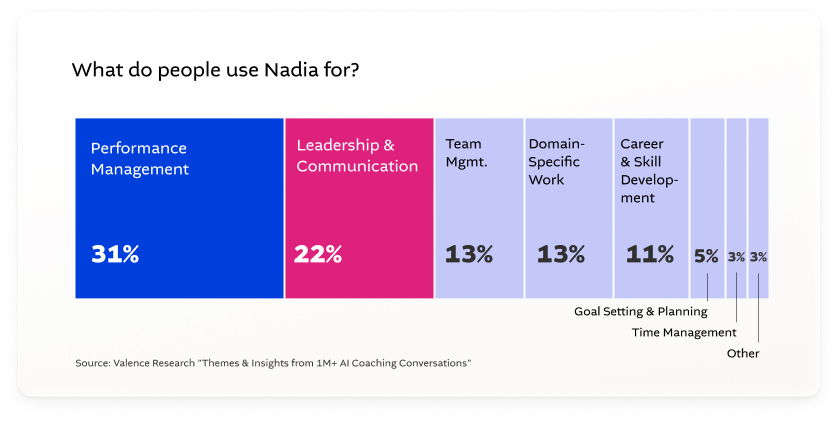
Performance management is also one of the best and most common starting use cases for AI coaching to have real organizational impact. It's a universal process, it's high-stakes for employees, and it's a moment where managers historically have been under supported.
The second-largest category, leadership and communication (22%), reinforces the pattern. Employees are coming to Nadia for help with conversations on how to give feedback, how to navigate a tense team dynamic, and how to show up differently as a leader.
These top use cases show where people seek help. The next question is what those conversations reveal about broader organizational strain.
The biggest risks are burn out, overwork, and a lack of appreciation and clarity.
Coaching conversations also surface signals of attrition risk. Across our conversations, the top two drivers were burnout and overwork (31%) and feeling devalued (26%). Together, they tell a clear story: people aren’t leaving because the work is too hard. They’re leaving because the work is too much and their contributions feel unseen.
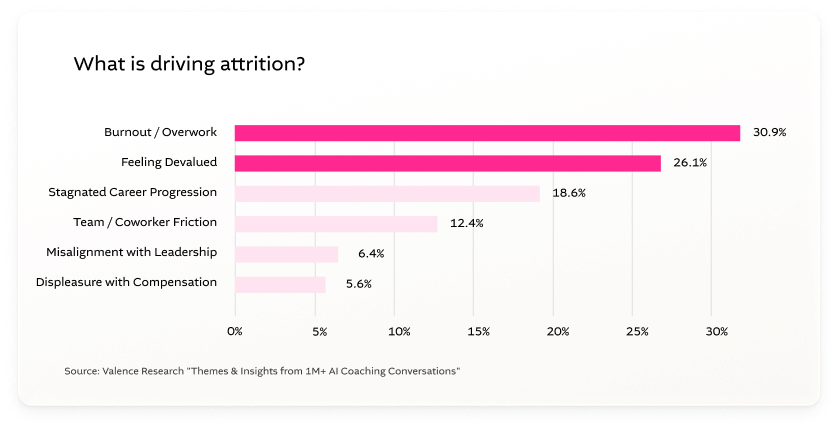
The surprise: Compensation, the retention lever organizations most commonly reach for, barely registers at 5.6%. Most retention problems are not compensation problems; they are issues with recognition, workload, and manager capability.
If attrition signals show the consequences of organizational strain, productivity blockers show how that strain is experienced day to day.
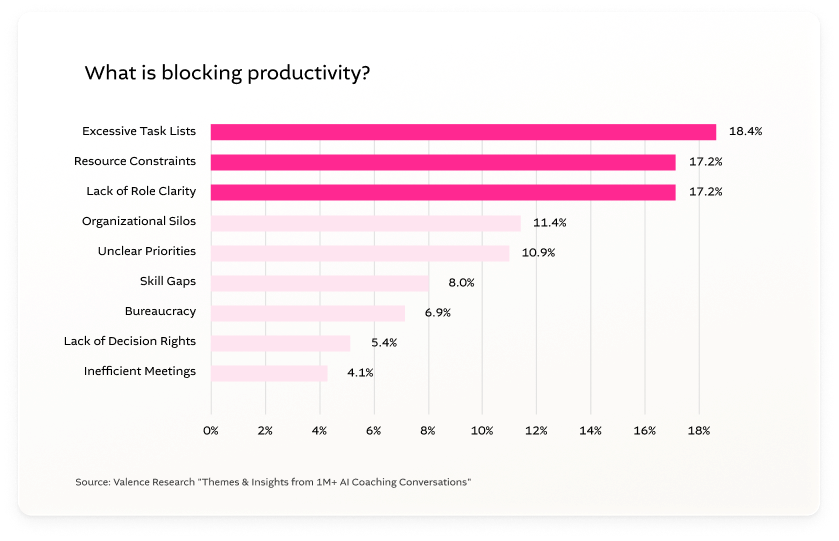
What's blocking productivity?
While training programs and process redesigns often target skill gaps (8%), inefficient meetings (4%), and lack of decision rights (5%), when employees describe what's getting in the way of doing their best work, the top productivity blocker is excessive task lists. While this can be an organizational problem, it can also signal a skill gap around prioritization, organization and how to manage many tasks. Not only can users bring these problems to an AI coach to solve them in the moment, but the coach can help build the foundational skills to overcome the problem in the future. In this instance Nadia can help users prioritize across tasks, develop ideas to finish tasks more quickly and stay organized amidst high workload.
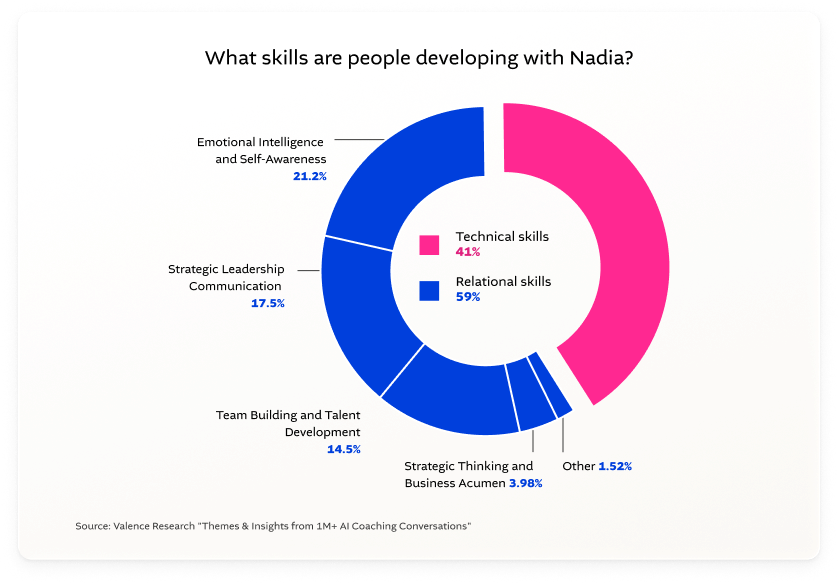
EQ skills are in high demand
Technical skill development leads as a single category at 41%. But taken together, emotional intelligence (21%), leadership communication (18%), team building (15%), and strategic thinking (4%) make up the majority of skill development.
This tracks with what the broader research is showing. A 2025 study published in Nature Human Behaviour, led by researchers from Harvard Business School and Northwestern's Kellogg School, analyzed over 1,000 occupations and found that foundational interpersonal skills — collaboration, communication, adaptability — are stronger predictors of career progression and earnings growth than specialized technical skills. As AI automates more technical workflows, the skills that differentiate are increasingly the ones machines can’t replicate.
Our data adds a new dimension to that research: when employees have an always-available coach, they self-select into developing exactly the skills the labor market is increasingly rewarding.
The conflict landscape confirms it
The coaching conversation data also includes a window into how people experience workplace conflict. Two-thirds of all conflicts that surface in coaching are relationship and communication issues, not task disputes, resource fights, or role disagreements. Fundamentally, conflict is about human interaction. Beyond technical skills, employees need to develop interpersonal skills, and this is a great place for AI coaching to improve team performance through individual skill development.
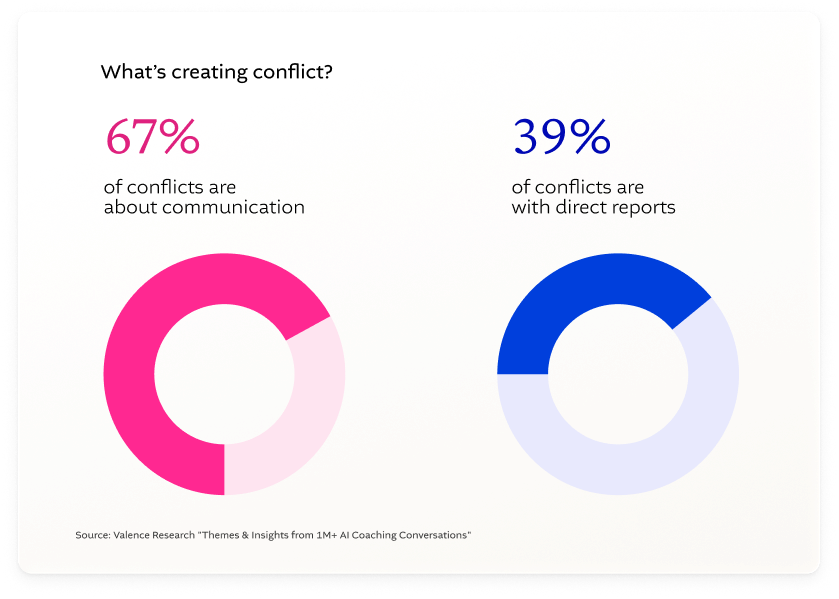
The #1 conflict relationship is with direct reports. Managers aren't going to Nadia to complain about their boss. They're going to Nadia for help managing the people they lead. This is one of the most meaningful signals in the entire dataset. It reveals a massive, underserved need: frontline and mid-level managers carrying the hardest interpersonal challenges in the organization, giving difficult feedback, managing underperformance, navigating team friction, with almost no real-time support before AI coaching.
The highest-leverage investment an organization can make is not another process redesign or compensation adjustment, it's equipping every manager and employee with the support to navigate the human side of work, every day, in the moments that matter.
That's what 1 million coaching conversations look like when coaching finally reaches the people who need it most.
Lorem ipsum dolor sit amet, consectetur adipiscing elit. Suspendisse varius enim in eros elementum tristique. Duis cursus, mi quis viverra ornare, eros dolor interdum nulla, ut commodo diam libero vitae erat. Aenean faucibus nibh et justo cursus id rutrum lorem imperdiet. Nunc ut sem vitae risus tristique posuere.
Lorem ipsum dolor sit amet, consectetur adipiscing elit. Suspendisse varius enim in eros elementum tristique. Duis cursus, mi quis viverra ornare, eros dolor interdum nulla, ut commodo diam libero vitae erat. Aenean faucibus nibh et justo cursus id rutrum lorem imperdiet. Nunc ut sem vitae risus tristique posuere.
Lorem ipsum dolor sit amet, consectetur adipiscing elit. Suspendisse 2 varius enim in eros elementum tristique. Duis cursus, mi quis viverra ornare, eros dolor interdum nulla, ut commodo diam libero vitae erat. Aenean faucibus nibh et justo cursus id rutrum lorem imperdiet. Nunc ut sem vitae risus tristique posuere.
Lorem ipsum dolor sit amet, consectetur adipiscing elit. Suspendisse 3 varius enim in eros elementum tristique. Duis cursus, mi quis viverra ornare, eros dolor interdum nulla, ut commodo diam libero vitae erat. Aenean faucibus nibh et justo cursus id rutrum lorem imperdiet. Nunc ut sem vitae risus tristique posuere.
.png)
